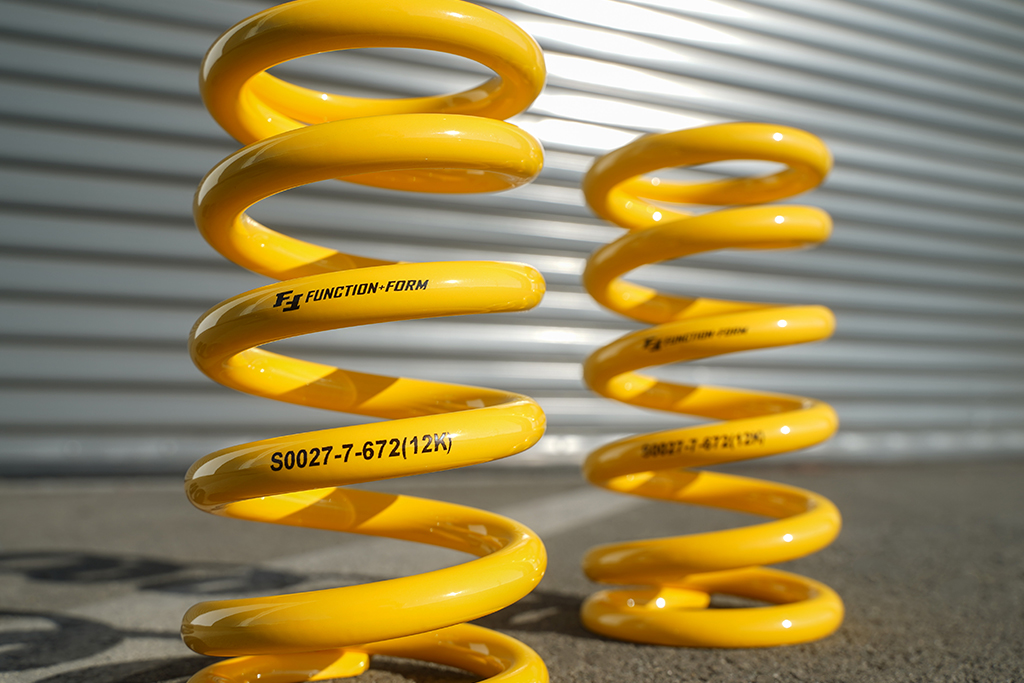
Spring Rate Conversion: kg/mm to lbs/in
Optimizing your vehicle’s suspension system is important for performance, and understanding spring rates is an essential part of that process. If you’re a car enthusiast or a professional mechanic, knowing how to convert spring rates from kg/mm to lbs/in can make a significant difference in achieving the right ride comfort and handling.
What is Spring Rate and Why Does It Matter?
The spring rate measures the stiffness of a suspension spring. It indicates how much force is needed to compress a spring by a specific distance. A higher spring rate means a stiffer spring, while a lower spring rate indicates a softer spring. The right spring rate is important for achieving the perfect balance between ride comfort and vehicle handling.
Understanding Spring Rates for Coilovers
When it comes to coilovers, the spring rate determines how much force is needed to compress the spring over a specific distance. Different spring rates are used depending on the type of driving, vehicle weight, and desired handling characteristics. A stiffer spring (higher spring rate) is ideal for performance driving, while a softer spring (lower spring rate) shares better comfort for daily driving.
How to Convert Spring Rates: kg/mm to lbs/in
Now that you understand the importance of spring rates, let’s look at how to convert from kg/mm to lbs/in.
To convert from kg/mm to lbs/in, use the conversion factor of 55.9974.
Here’s the simple formula:
Spring Rate (lbs/in) = Spring Rate (kg/mm) * 55.9974
Example Conversion:
If you have a spring rate of 10 kg/mm, multiply by 55.9974:
10 kg/mm * 55.9974 = 559.974 lbs/in
So, 10 kg/mm is approximately equal to 560 lbs/in.
Spring Rate Conversion Chart
Here’s a quick reference chart to make your conversions even easier:
lbs/in to kg/mm Conversion:
- 700 lbs/in = 12.5 kg/mm
- 650 lbs/in = 11.6 kg/mm
- 600 lbs/in = 10.7 kg/mm
- 550 lbs/in = 9.8 kg/mm
- 500 lbs/in = 8.9 kg/mm
- 450 lbs/in = 8.0 kg/mm
- 400 lbs/in = 7.1 kg/mm
- 350 lbs/in = 6.2 kg/mm
- 300 lbs/in = 5.3 kg/mm
250 lbs/in = 4.5 kg/mmkg/mm to lbs/in Conversion:
- 16 kg/mm = 896 lbs/in
- 15 kg/mm = 840 lbs/in
- 14 kg/mm = 784 lbs/in
- 13 kg/mm = 728 lbs/in
- 12 kg/mm = 672 lbs/in
- 11 kg/mm = 616 lbs/in
- 10 kg/mm = 560 lbs/in
- 0 kg/mm = 504 lbs/in
- 5 kg/mm = 476 lbs/in
- 0 kg/mm = 448 lbs/in
- 5 kg/mm = 420 lbs/in
- 0 kg/mm = 392 lbs/in
- 5 kg/mm = 364 lbs/in
- 0 kg/mm = 336 lbs/in
- 5 kg/mm = 308 lbs/in
- 0 kg/mm = 280 lbs/in
- 5 kg/mm = 252 lbs/in
- 0 kg/mm = 224 lbs/in
- 0 kg/mm = 168 lbs/in
- 0 kg/mm = 112 lbs/in
Selecting the Right Spring Rate for Your Vehicle
The correct spring rate depends on a variety of factors, such as your vehicle’s weight, your driving style, and the road conditions. A stiffer spring is better for performance driving, while a softer spring is more suited for daily use or comfort driving. To find the right spring rate for your car, consider:
- Vehicle Weight: Heavier vehicles need stiffer springs.
- Driving Style: Performance drivers may prefer stiffer springs, while daily drivers may prioritize comfort.
- Road Conditions: Rougher roads require softer springs for better comfort.
Explore Our Range of Coilover Springs
If you’re looking to upgrade or replace your suspension components, Function and Form offers various coilover springs and suspension kits.
Frequently Asked Questions About Spring Rates
- How do I convert kg/mm to lbs/in?
Multiply the spring rate in kg/mm by 55.9974 to get the equivalent in lbs/in.
- Why do spring rates matter for my vehicle’s suspension?
The spring rate affects how your vehicle handles bumps, corners, and overall driving comfort. A proper spring rate ensures optimal suspension performance.
- What is the best spring rate for daily driving?
For daily driving, a moderate spring rate is recommended to provide a good balance between comfort and handling. Softer springs (lower spring rates) are better for comfort, while stiffer springs (higher spring rates) offer improved handling, especially on smoother roads. However, it’s important to consider your vehicle type and the road conditions where you drive most often.
Get the Right Spring for Your Ride
Understanding spring rates and how to convert between kg/mm and lbs/in is vital for optimizing your vehicle’s suspension. With the right spring rate, you can significantly improve ride quality and handling. Use our spring rate conversion chart and guide to choose the best suspension components for your car.
Ready to upgrade your suspension? Contact us today to explore our wide selection of premium coilover springs and suspension components. Let us help you choose the perfect spring rate for your vehicle’s performance and comfort.
Purchase Springs: https://www.f2suspension.com/product-category/springs/